Beechwood
Images
Musical Adventures
Guitars (Part 2)
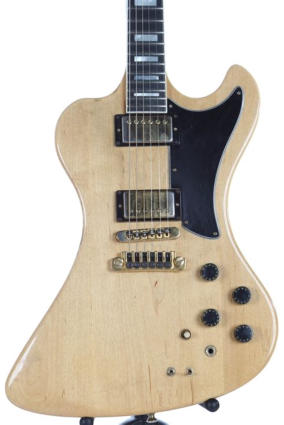
...... Gibson RD Artist.
Basically, a nice sales assistant at Peter Cook Guitars (Nev)
showed me this instrument and intoned "Open your wallet and
repeat after me - "Help Yourself, Help Yourself""
A beautifully padded hard case enclosed a guitar with a superb
Maple body, flawless block inlaid ebony fingerboard, inlaid
headstock, fine-tuning at the bridge and to top it off, built-in audio
expander and compressor courtesy of none other than Robert
Moog.
There was, of course, one problem......
This was an expensive and unusual guitar but I recall that my
attempts to sell or part-exchange it met with almost insulting
indifference. I don’t remember what happened to it but I suspect
that today it would be worth a great deal of money.
You may well, at this point, wonder what sort of idiot would keep
buying and trading Gibson guitars when he wanted to sound like Hank
Marvin?
Well, first off, Gibson guitars were, in almost any respect much better
built than Fender and I appreciated this.
Let's be honest, Gibson guitars came from a lineage of musical
instrument craftsmanship culminating in the lovely carved maple top
Jazz models and the superb, maple on mahogany bodied Les Paul
range.
Fender guitars, on the other hand were simple and cheap - well, not in
Britain but that's another story - a simple slab body of alder or ash, a
one-piece, bolt-on maple neck sometimes with a rosewood
fingerboard, I could go on.
However, there was a good reason why Steve Cropper played a Fender
Telecaster and Hank played a Stratocaster; that wonderful incisive
sound, helped by light woods and single coil pickups which could cut
through the music like nothing else.
I know that I am generalising furiously here but...
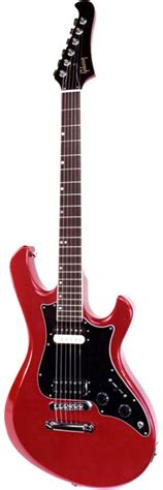
.......anyway, in 1981 Gibson introduced "The Victory" which they
claimed and hoped would fit into both camps, hence the name. With a
maple body and glued-in maple neck as well as switchable
humbucking pickups it certainly straddled the two camps. There was
also a three-pick-up version. It was, I believe, a commercial failure.
I remember it as a very well made and versatile instrument and of
course I bought one and used it quite happily for some time.
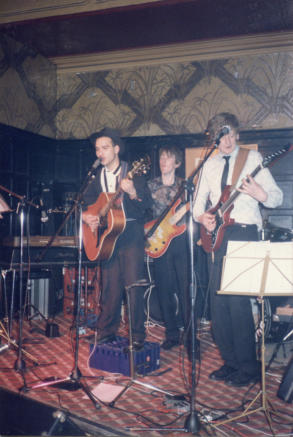
(Left) The Gibson Victory in action; a gig at the Swan in Fulham with a
guest-spot vocalist, Gerry, who was short in stature - hence the beer
crate.
(ps I note that this guitar has been re-issued, 2025)
(pps I’ve just bought one)
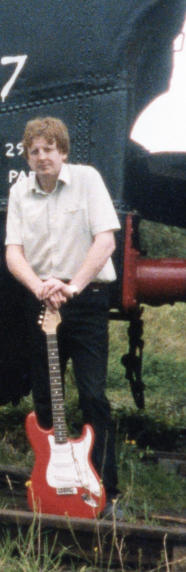
It was at this point that I very nearly bought a Fender
Strat, however, as I said previously, American guitars
were expensive in Britain and there were dark
mutterings about the quality of Fender instruments
since the company was sold to CBS in1965. So I bought
a Tokai "Breezy Sound" Stratocaster. These Japanese
imports were about half the price of an American
import Stratocaster and a bit of a leap in the dark; there
was much mockery from "real Strat" owners but it
would seem that Tokai were very good replicas of
vintage guitars and compared favourably with the
genuine article, particularly now that the CBS Fenders
seemed to have lost quality. I changed the pickups and
used this guitar quite happily for some years.
For what it is worth I do recall that Fender Stratocasters
in the 1960’s seemed to have a very variable feel and
sound; individuality perhaps. Everything was much
more hand-made in those days which can work both
ways. My friend and fellow guitarist, Bob bought a pre-
CBS strat from George Gruhn in the States and it did
sound good but I always prefered to play my Tokai.

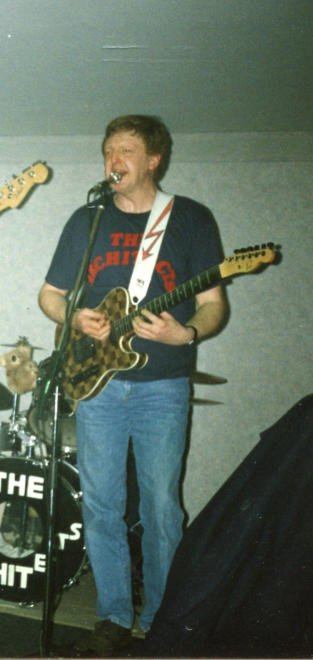
Now, here's an oddity. This Telecaster was one of
two built by the guitar repair man at the Ealing
Music Centre. He has a Polish name which I
cannot recall and all his guitars were "Poleax"
instruments.
The body is, I guess, mahogany with white
binding and is covered in a strangely patterned
wooden veneer; (It's sister guitar, I was told, was
a grey herringbone pattern).
The neck is maple with a rosewood fingerboard.
Schaller hardware and pickups produce a clean
but solid sound.
This guitar is well built and plays and sounds
beautiful.
Also, get this, it is the only one! no one else in the
world has one of these. I used it for years and it
still hangs on my wall to be picked up and
played.
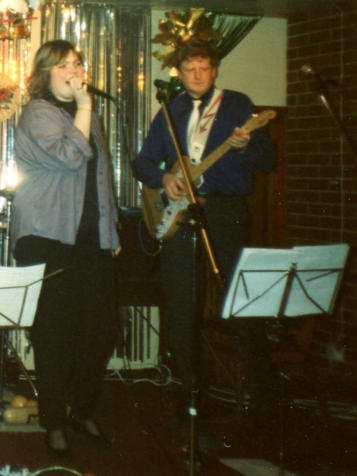
Another Fender guitar, a Thinline Telecaster
seen here in action as I accompany the
incomparable Jacky Smith.
By now I was becoming a confirmed
Telecaster player but I have no idea why I
bought this style of Telecaster.
I was playing lots of social clubs and
perhaps thought it would be a bit smoother
than the usual. It was a good, easy playing
guitar. I recall that at some point I changed
the pickups in an attempt to get a bit more
attitude to the sound.
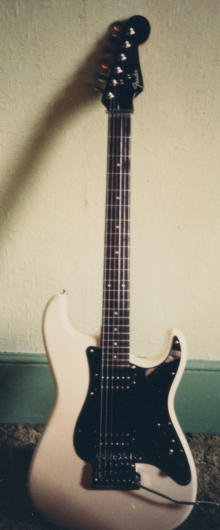
I must mention a couple of guitars that
also passed through my hands at this
time. One was a Fender Stratocaster in
Frost White with two humbucking
pickups and a lockable trem arm. I first
saw one of these models in the very
capable hands of Graeme Taylor
(Gryphon, Home Service guitarist) It
looked and sounded great; as well it
would being played by Mr Taylor. I saw
one of these in Peter Cook guitars and
bought and used it for a while. Funnily
enough I cannot find reference to this
guitar today; Here are some photos to
show that it did exist:
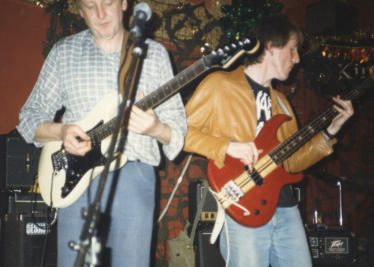
On stage with brother playing his thru-neck Aria bass
I also owned a Paul Reed Smith Classic Electric for a short time.
These are classy (and expensive) guitars......I bought my PRS from Chandler Guitars in Kew (Guitars to the
Gentry)
This guitar had two octave fingerboard with a strange, for me, scale-length.
By now I was used to a Telecaster neck and could generally find the 12th fret without looking down, but
this did cause me problems with the PRS.
After an embarrasing incident on a dark stage at a pub in Islington, Mr Smith and I parted company by
mutual consent.
I also owned a guitar built by Paul Reed’s brother, Gordon, a very nice solid 12 string which was reviewed
very favourably in Guitarist magazine. I was able to buy the review guitar at a good price and it was very
nice and unusual. I wish I had kept it.














© Lorem ipsum dolor sit Nulla in mollit pariatur in, est ut dolor
eu eiusmod lorem 2013

SIMPLICITY